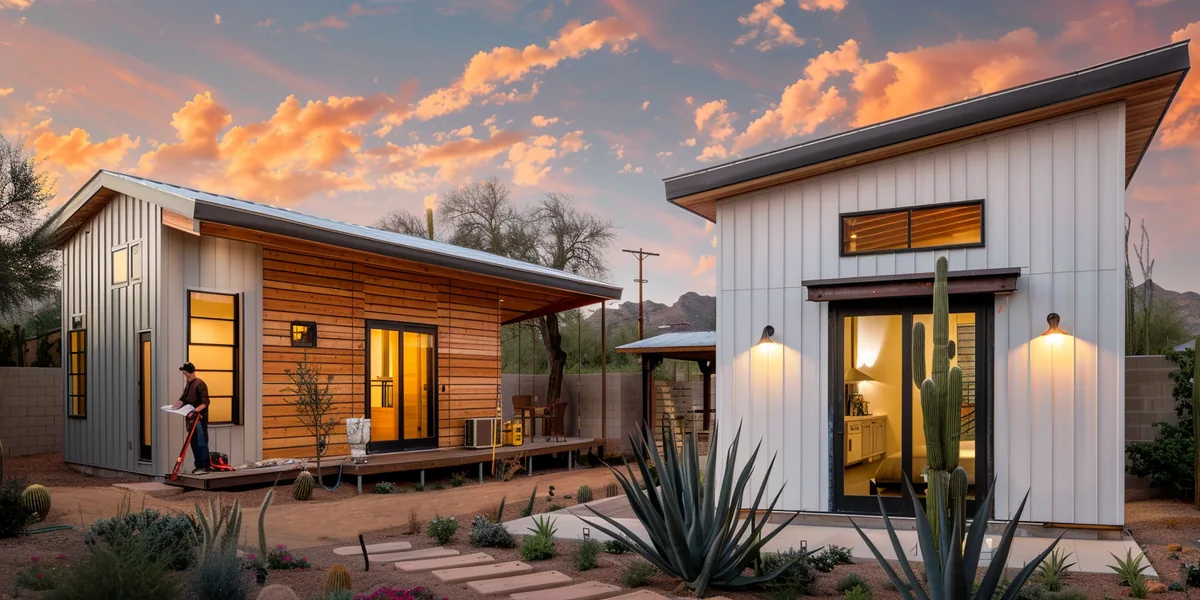
If you've heard that Arizona passed a new law making it easier to build a backyard casita — you heard right. House Bill 2720, signed by Governor Katie Hobbs on May 21, 2024, is the most significant shift in Arizona's accessory dwelling unit (ADU) rules in years. It removes real obstacles that previously blocked homeowners from building, and it sets a statewide floor that cities can no longer fall below.
But there's also a lot of misunderstanding floating around about what HB 2720 actually does. We've talked to homeowners who think it eliminates all restrictions on ADU construction. It doesn't. We've talked to others who think their HOA is powerless to stop them now. Also not true.
This is the plain-English breakdown you actually need before you make any decisions about your property.
What Is HB 2720?
HB 2720 is a state law that requires every Arizona city with a population of 75,000 or more to allow accessory dwelling units — detached or attached — on single-family residential lots. Cities had to update their local codes to comply by January 1, 2025, and as of early 2026, those rules are fully in effect across the Phoenix metro.
The law was designed to address Arizona's housing shortage by making it easier for existing homeowners to add housing supply without requiring new land, new infrastructure, or new city zoning changes. A backyard casita on an existing residential lot is exactly what the legislature had in mind.
For full technical language, you can read HB 2720 on the Arizona Legislature's official site. But for everything that actually matters to a homeowner in the Phoenix Valley, keep reading.
What HB 2720 Allows
Here are the protections and permissions the law gives you — the ones cities can no longer take away.
You Can Build at Least One Detached ADU on Your Lot
Any city covered by the law must allow you to build at least one attached ADU and one detached ADU on your single-family lot. That means a freestanding backyard casita — separate from your main home, with its own entrance and its own life — is now a legal right in Phoenix, Scottsdale, Tempe, Mesa, Chandler, and every other large Arizona city.
No More Owner-Occupancy Rules (for Long-Term Rentals)
Previously, some Phoenix-area cities required the property owner to live on-site if they wanted to rent an ADU. HB 2720 eliminates that requirement for long-term rentals (leases of 90 days or longer). You can live somewhere else entirely and rent out both your main home and your casita — the state no longer lets cities stop you.
This is a big deal for investors and homeowners who want to generate rental income from a backyard casita.
No Required Off-Street Parking
Cities can no longer require you to add extra parking spaces as a condition of building an ADU. If your lot already meets its parking requirements for the primary home, that's sufficient. This removes a restriction that killed ADU projects on smaller urban lots.
No Design-Match Requirement
Cities cannot require that your ADU match the exterior architecture or materials of your primary home. Your casita can have its own look. This gives builders and homeowners more design flexibility.
Size Minimums the City Must Allow
State law sets size thresholds that cities must allow at minimum:
- Lots under 10,000 SF: the lesser of 75% of the primary dwelling's floor area or 1,000 SF
- Lots over 10,000 SF: the lesser of 3,000 SF or 10% of the net lot area
Cities can be more permissive than these limits. They cannot be more restrictive.
Setbacks Capped at 5 Feet
Cities cannot require setbacks greater than 5 feet for ADUs. If your existing lot has tight side or rear yards, this matters — you can likely build closer to the property line than you could have under the old rules.
What HB 2720 Does NOT Do
This is where a lot of homeowners get tripped up. The law creates a statewide floor — but it doesn't flatten every obstacle.
It Does NOT Override Your HOA
This is the most important thing to understand, and it's also the most commonly misunderstood.
HB 2720 explicitly preserves the enforceability of private restrictive covenants — including HOA CC&Rs. If your homeowners association's governing documents prohibit detached structures, additional dwellings, or rental use, the state law does not override them. Your HOA can still say no.
This is not a technicality. In many of the Valley's most desirable neighborhoods — including parts of Arcadia, Paradise Valley, and the Biltmore corridor — HOA restrictions are the primary gating factor for ADU projects. Before you get excited about HB 2720, you need to know what your CC&Rs say.
The fastest way to find out: run our free HOA eligibility check. Enter your address and we'll tell you whether your lot is in an HOA-governed area and what restrictions typically apply in your neighborhood.
Short-Term Rentals Have Strings Attached
HB 2720 does protect your right to rent an ADU as a long-term rental. But for short-term rentals (under 90 days — think Airbnb, VRBO), cities retain the right to impose an owner-occupancy requirement. That means if you want to run your casita as a short-term rental, you may need to live on the property.
In Scottsdale specifically, this rule is on the books: if your ADU is used as a vacation rental or short-term rental, the property owner must reside on the premises. Phoenix is more permissive on this front.
If Airbnb income is your goal, the casita strategy still works — but the rules vary by city and the STR permitting process is separate from the ADU permit. We walk through this in detail on our short-term rental casita page.
It Doesn't Eliminate the Permitting Process
You still need a permit. HB 2720 streamlines and standardizes ADU approvals, but it does not create a permit-free path to building a casita. Every ADU in the Phoenix metro requires a formal building permit, engineering drawings, and inspections.
In Phoenix, that process typically takes 60–90 days and costs $2,500–$4,200 in permit fees. In Scottsdale, it's typically 120–180 days and $5,000–$8,000 — Scottsdale has adopted stricter local standards within the state framework.
For a full breakdown of the permit timeline and what to expect at each stage, see our Arizona ADU Guide.
Phoenix vs. Scottsdale: Where the Rules Differ
Both cities are covered by HB 2720, but they've implemented it differently. Here's how they compare on the issues that matter most:
| Phoenix | Scottsdale | |
|---|---|---|
| Detached ADU allowed | Yes | Yes |
| Max ADU size (lot < 10K SF) | 1,000 SF | 1,000 SF |
| Second ADU size limit | Up to 1,000 SF | 500 SF |
| Owner-occupancy (long-term rental) | Not required | Not required |
| Owner-occupancy (STR) | City may require | Required |
| Permit timeline | 60–90 days | 120–180 days |
| Permit fee range | $2,500–$4,200 | $5,000–$8,000 |
The practical takeaway: Phoenix gives homeowners more flexibility, particularly for investors who don't plan to live on-site. Scottsdale is more permissive on lot sizes in its upper range, but more restrictive on STR use and slower on permits.
For neighborhood-specific information, see our service area pages for Arcadia (85018), Scottsdale (85251), and Paradise Valley (85253).
What This Means for Your Property Value
The financial case for building a casita has never been stronger in the Phoenix Valley. HB 2720 didn't create demand for ADUs — that demand has always existed. What it did was remove the bureaucratic and legal obstacles that prevented homeowners from acting on it.
Here's what the math looks like in broad strokes: a well-built casita in a desirable Valley zip code can generate $1,500–$3,000/month in long-term rental income, or meaningfully more as a short-term rental in the right neighborhoods. Against a typical casita build cost in the Phoenix market, that's a payback period most homeowners find compelling.
Beyond rental income, ADUs add permanent appraised value to a property. A detached casita in a neighborhood like Arcadia or Paradise Valley isn't just income — it's equity.
For multigenerational families, the calculus is different but the value is just as real. A private in-law suite on your property keeps family close without sharing a front door — something no financial model fully captures.
The Three Things to Do Right Now
If HB 2720 has you thinking seriously about a backyard casita, here's where to start.
1. Check your HOA situation first. Nothing else matters until you know whether your lot is encumbered by private covenants that restrict ADU construction. Run our free HOA eligibility check — it takes two minutes and tells you where you stand before you spend time or money on anything else.
2. Understand your lot. Size, orientation, utility access, and setbacks all affect what you can build and where. Our team looks at all of this in an initial consultation.
3. Know your goal. The right casita model and design depends on what you're building for — rental income, family, guests, a home office, or some combination. Browse our five models to get a sense of the options, from The Studio (390 SF) to The Villa (1,032 SF).
When you're ready to talk through the specifics of your property, request a free quote here. We'll cover lot eligibility, estimated build cost, permitting timeline, and projected return — in one conversation, no obligation.
Frequently Asked Questions
Does HB 2720 apply to my city?
If you live in an Arizona city with a population of 75,000 or more, yes. This includes Phoenix, Scottsdale, Mesa, Tempe, Chandler, Gilbert, Glendale, Peoria, and Surprise. Rural towns and smaller cities are not covered.
Does HB 2720 override my HOA?
No. The law explicitly preserves private restrictive covenants. If your HOA prohibits ADUs or additional detached structures, those restrictions remain enforceable. Check your HOA status here.
Can I rent my casita on Airbnb under HB 2720?
Short-term rentals are allowed, but cities may require the property owner to live on-site for STR use. Scottsdale requires this; Phoenix has more flexibility. Your city's STR permitting process is also separate from the ADU building permit. See our short-term rental casita page for details.
Do I still need a building permit?
Yes. HB 2720 does not eliminate the permitting process — it standardizes and streamlines it. You'll still need architectural drawings, a site plan, and city review before breaking ground.
How big can my casita be under HB 2720?
On lots under 10,000 SF, the lesser of 75% of your primary home's floor area or 1,000 SF. On lots over 10,000 SF, the lesser of 3,000 SF or 10% of the lot area. Our five models range from 390 SF to 1,032 SF — all designed to fit the most common Valley lot sizes.
How do I finance a casita build?
The most common options are a HELOC, cash-out refinance, or construction loan. We've partnered with lenders who specialize in ADU financing in the Phoenix market. See our financing options page for a breakdown.
How long does it take to build a casita?
From initial consultation to move-in day, most Valley Casita Co. projects take 6–9 months — including permitting. Phoenix projects typically permit faster than Scottsdale. For a full timeline, visit our process page.
Last updated: July 2026. Arizona ADU law continues to evolve — this article reflects the current rules under HB 2720 and subsequent local code adoptions. For the most complete and current ADU ruleset for Phoenix and Scottsdale, see our full Arizona ADU Guide.
Ready to find out if your lot qualifies?
Start your free HOA eligibility check →